Agronomists set up product demos, record crop measurements, and track results across markets.
Picture an agronomist standing in a field with a tablet in one hand and a crop in the other, recording how that crop is responding to a product. That moment — repeated across seasons, markets, and thousands of plots — is how a global fertilizer brand proves its products actually work. Yet it was still being run on paper, memory, and scattered spreadsheets.
I led the UX for the app that changed that: a field-first tool that lets agronomists create product demos, capture crop measurements on the spot, and keep track of the results that turn a trial into proof. The first challenge wasn’t design at all — it was getting deep into a highly specialised business domain, fast.

role
At Fram Creative
Duration
1+ year
Closed in 2022
Market
With thoughts of expansion
overview
The app digitalises how the brand’s agronomists run product demonstrations — structured field trials that compare the company’s products against a baseline to show farmers the difference for themselves. The users are a narrow, expert audience: agronomists working across different markets, crops, and growing conditions, each fluent in the science but previously without a consistent tool to capture it.
My remit ran end to end — from research through interaction and visual design to the underlying structure of the trial data. Because the audience was so specialised, the work began with immersing myself in their world: learning the logic of how demos are designed, what gets measured and when, and how those specifics shift from one market to the next. I translated that understanding into a workflow simple enough to use standing in a field, yet structured enough to make every trial comparable.
The Problems
Agronomy trials carry real complexity — crops, growth stages, treatments, application timing, and the measurements that matter differ by product and by market — and I had to understand it deeply and quickly to design anything credible for the people who live it every day.
What made it harder still was how fragile that manual process was in practice. Readings were jotted into personal notes; agronomists couldn’t always get out to the plot in time to track a crop; and the date marking the best window to take a measurement was easy to forget — and in a trial, miss the window and the reading loses much of its value. I had to get inside that logic and translate it into a scalable UX that was easy to understand and easy to present to stakeholders — clear enough that both the experts in the field and the people relying on their results could follow it at a glance.
Goal 1:
Digitalise how demos are created
Replace ad-hoc, manual setup with a guided, structured workflow that captures a trial the same way every time — so results are consistent and comparable across agronomists, crops, and markets from the start.
Goal 2 :
Make field capture effortless.
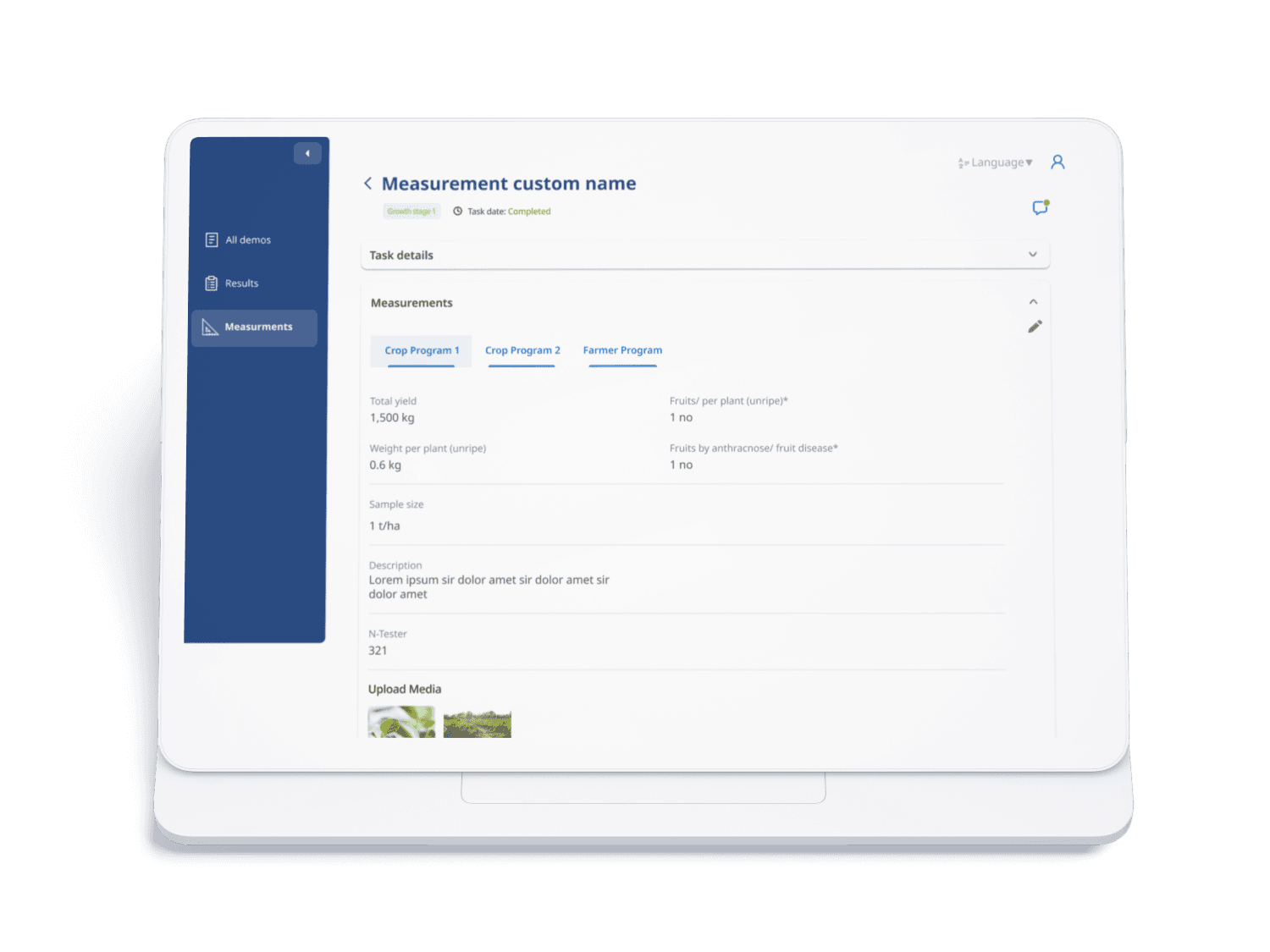
Design measurement recording for the reality of the field: fast, offline-first, and built for quick structured input and photo capture, so an agronomist can log a reading in seconds and move on.
Goal 3:
Keep results trackable and comparable.
Give agronomists a clear way to follow a trial’s progress over time and hold results side by side — turning scattered records into a coherent, growing body of proof.
Reflection
The app gave a specialised, manual practice a consistent digital home. Trials that were once created differently by every agronomist now follow one structured pattern, which means results are captured the same way, tracked over time, and comparable across markets instead of trapped in one-off spreadsheets and notebooks.
For the agronomists, the change was felt in the field. Recording a measurement became a matter of seconds rather than a chore to reconcile later, and because the workflow was built for real conditions — offline, one-handed, in the sun — the tool fit into their day rather than fighting it. Because the design started from their actual expertise, adoption felt like a sharper version of how they already worked, not a system imposed on top.
And the value compounds: consistently captured trials build into a reliable, growing evidence base the brand can use to demonstrate its products with confidence. The structured trial model was designed to scale — extending to new crops, products, and markets without re-solving the foundations each time.
