Digitalising cross-channel media planning for four media worlds
At scale, media planning is deceptively hard. A single campaign might run as a billboard in the CBD, a full page in the morning paper, a drive-time radio spot, and a programmatic digital flight — four channels, four sets of rules, four different ways of thinking about time, space, and inventory. For one of Singapore’s largest media groups, all of it was still being coordinated through a sprawl of spreadsheets and hand-maintained tables.
I led the UX for the platform that replaced them: a single system to plan, buy, and schedule positions across all four media pillars, owned end to end — from domain research through interaction and visual design to the underlying design system.
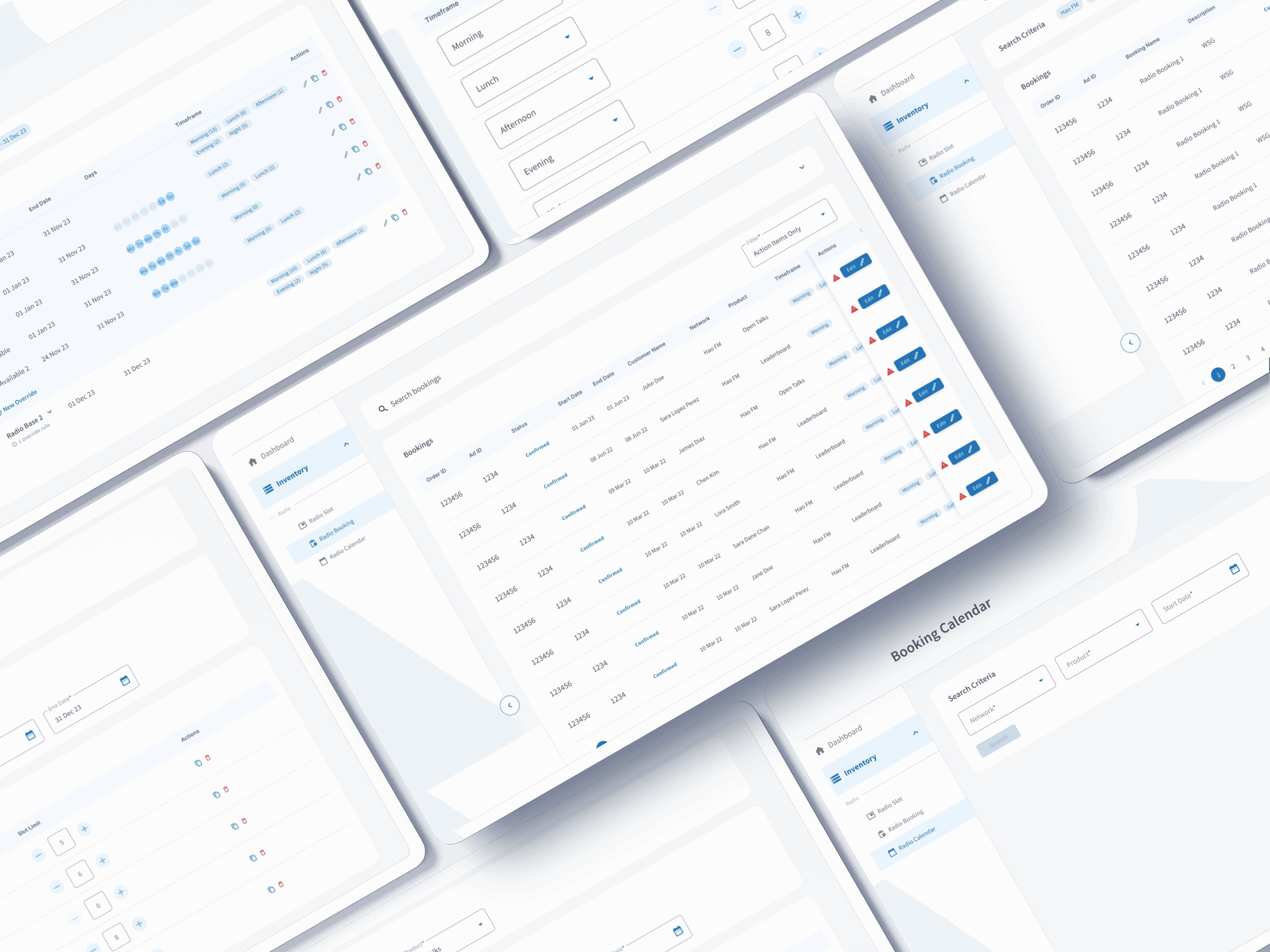
role
UX Lead
At Fram Creative
Duration
1+ Years
Closed in 2024
Market
Asia
With worldwide ambitions
overview
Designing clarity for complexity
The 360 Media Scheduler is an internal planning and scheduling platform for the group’s editorial and media-planning divisions. Its users aren’t consumers — they’re specialists, each fluent in the particular logic of their own channel, and each previously working in isolation from the others.
The remit was to digitalise a manual, spreadsheet-bound process and bring four historically separate workflows — Out-of-Home, Print, Radio, and Digital — into one coherent product. That meant designing not just screens, but a shared way of working: a single source of truth for what’s planned, booked, and scheduled, and a unified interaction model that holds across four very different domains.
I worked directly with each division to learn their reality first-hand, then translated that understanding into a system simple enough for daily use without stripping out the detail experts depend on.
The Problems
The starting point was the legacy toolkit itself: a set of dense spreadsheets and reference tables that encoded years of institutional knowledge but offered no structure, no validation, and no shared visibility. Plans lived in separate files, tracking was manual, and the risk of error grew with every channel added to a campaign.
The problem was to understand each domain deeply enough to respect its specifics, then reconcile four models into one experience . That required getting into the shoes of a niche, expert audience, mapping every step of their process, and holding all four sets of constraints in one view.
Goal 1:
Create a single source of truth
Replace scattered spreadsheets with one system where every planned, booked, and scheduled position lives in one place — giving planners constant, real-time oversight of the full 360 picture instead of a patchwork of files.
Goal 2 :
Unify without flattening
Design a shared interaction model and data structure that align all four channels, while preserving the distinct logic each domain requires. Keep the default experience simple for the common path, and let each channel’s specialist detail live under the hood where it’s needed.
Goal 3:
Make the transition effortless
Lower the barrier from spreadsheet to platform so daily planning is faster, not just different — familiar enough to adopt quickly, structured enough to prevent errors, and clear enough to keep continuous track of every campaign across every pillar.

platform
Impact & key results
The platform gave a fragmented, manual process a single home. Four workflows that had always run in parallel now share one system, one language, and one view of the plan — turning cross-channel coordination from a spreadsheet-reconciliation exercise into a single, trackable flow.
For the teams, the shift was practical: less time spent re-keying and cross-checking, fewer opportunities for error, and a live, shared picture of what’s scheduled where — across OOH, Print, Radio, and Digital — at any moment. Because the design started from each division’s actual way of working, specialists could move onto the platform without giving up the detail their jobs demand, which made adoption feel like an upgrade rather than a compromise.
Beyond the immediate launch, the work laid a foundation. The unified data model and the design system built to support it created a consistent, scalable base the group can extend to new channels, campaign types, and reporting needs — so the product can keep pace with how media planning itself evolves.
Where you have real numbers — planning time saved, error reduction, adoption across divisions, campaigns managed — weave them into this section. The senior roles you’re targeting specifically reward being able to talk about impact in metrics.


